Collingwood Notables Database
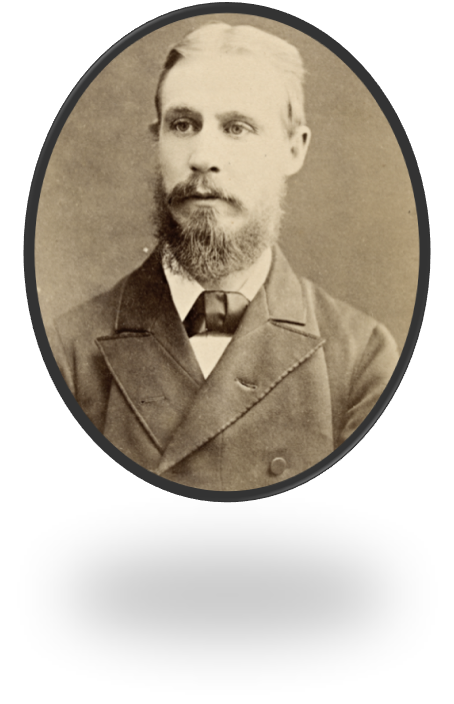
Benjamin William Tapner
1861-1930
Architect, councillor, Mayor, honorary magistrate
Collingwood-born Benjamin William Tapner was an active participant in the Abbotsford and Clifton Hill community as an architect, member of the congregations of St Philip’s and St Andrew’s churches, and Mayor and councillor. Having earlier lost his son in the Great War, he also designed the Soldiers Memorial Hall, (named on completion the Returned Soldiers and Sailors Hall), which still stands in Hoddle Street. His photograph, in mayoral robes, hangs in the Collingwood Town Hall.
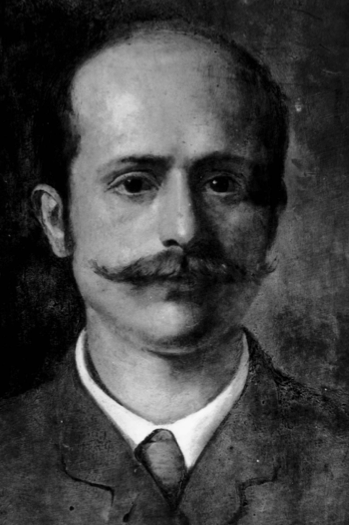
Marcus Tartakover
c. 1804-1882
Pawnbroker
Marcus and his son Samson conducted a pawnbrokers’ business in Smith Street. It has claims to be one of the longest-running businesses in the shopping street, since it apparently existed from 1858 until the mid twenties. Marcus was an Austrian-born Jew and married his French wife in Paris, where he was occupied as either a pawnbroker or jeweller.
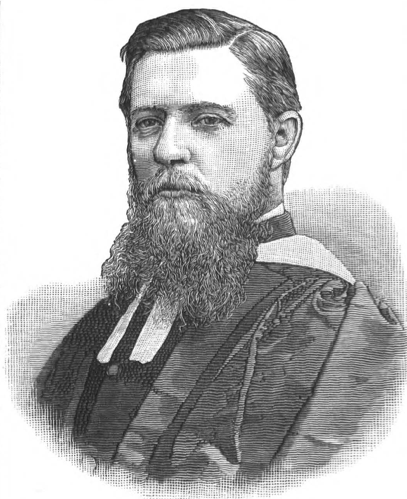
Leonard Terry
1825-1884
Architect
Terry was one of Melbourne’s notable nineteenth century architects and left Victoria an outstanding legacy of banks and ecclesiastical buildings. He spent the last years of his life at Campbellfield near the Yarra, which he rented from local manufacturer Henry ‘Soapy’ Walker.
Charles Henry Tolhurst
1864-1924
Solicitor
Charles was one of the sons of Henry E Tolhurst, Collingwood city surveyor and engineer. The family lived in Frankfurt House, a two-storey bluestone house in Clarke St with a tennis court and large garden. By 1888 Charles was regularly advertising his Queen Street practice in partnership with McFarlane in the local paper. This was the same year he was initiated into the Masonic Earl of Carnarvon Lodge. In 1896 the firm became Tolhurst and Druce (which still exists in 2016 under the name Tolhurst Druce and Emerson).
Ella Tolhurst
1877-1967
Teacher
Ella Tolhurst was the youngest daughter of Henry Tolhurst, an architect who was the surveyor and engineer for the City of Collingwood. The family moved into Clarke Street Abbotsford in the 1880s. Living in a substantial house with a tennis court, the four daughters were well occupied with home duties and social engagements among their many connections in the district, while the two surviving sons pursued careers in the law and surveying. Ella, however, broke away from the life lived by her three elder sisters to forge a professional career.
Henry Edmeades Tolhurst
1837-1902
Architect, engineer, surveyor
Henry E Tolhurst was an architect who was appointed Collingwood city surveyor and engineer in 1883. Tolhurst continued his practice as an architect while working for the council and was responsible for some notable Collingwood buildings. These included the east aisle of St Joseph’s Church in Otter Street, and the Shamrock Brewery in Victoria Street, a bi-chrome brick building, since demolished, whose striking appearance probably once rivalled the Yorkshire Brewery. A somewhat plainer building, but typical of Collingwood industry, was Whybrow’s shoe factory in Stafford Street.
Charles Trescowthick
1868-1946
Boot and shoe manufacturer
When Charles Trescowthick died at the age of 79 he was referred to as the ‘oldest boot and shoe manufacturer in the state’. Son of Cornish migrants, Trescowthick was born in Ballarat East. He moved to Melbourne and in 1883 began his apprenticeship with James and McGan in George Street, Fitzroy. He soon set up his own business and was actively engaged in boot manufacturing until the time of his death.
Ivor Withall Trescowthick
1906-1998
Shoe manufacturer, founder of Julius Marlow
When Collingwood was the capital of Australia’s footwear industry, the Trescowthick family were a prominent part of the local trade. Ivor Trescowthick was the nephew of the prominent boot manufacturer, Charles Trescowthick. Ivor started his own shoe factory, not far from his uncle’s, in 1928 and later started the Julius Marlow brand, still sold today.
Charlie Utting
1923-2009
Footballer, councillor, mayor
Charlie Utting was a nuggety and feisty footballer with relentless determination, courage, resilience and unflinching toughness who made life very difficult for opponents. He was a key contributor to Collingwood’s re-emergence as a VFL force in the years after 1943.
Beatrice Vale
1876-1945
Poet, missionary in China
Beatrice was one of the five talented daughters of William Vale, Member of Parliament, and his wife Rachel. In the 1880s the family moved into Mayfield in Abbotsford. In this lovely old house May and Elsie painted and gave art lessons, Grace studied for a medical career, and Faith started a school. Beatrice, who attended Presbyterian Ladies College, also showed artistic gifts and studied at the National Gallery School, but would eventually find her metier in writing poetry, prose and plays. The family was close-knit; a delightful photo of the five sisters taken in Allen’s Smith Street Collingwood studio conveys an impression of quiet strength, intellect, and moral purpose.
Grace Vale
1860-1933
Doctor, suffragist
Grace Vale was among the first group of women to study medicine at Melbourne University. An Abbotsford resident, she was a member of the prominent and talented Vale family. Grace was born in Richmond, the eldest daughter of William Mountford Kinsey Vale, stationer and later Member of Parliament, and Rachel Lennox. The family soon moved to Ballarat, returning to Melbourne in 1872 where Grace attended Gurner House School, St Kilda. The family spent the years 1874 to 1878 in London as Mr Vale had taken up an appointment there. Back in Melbourne, she studied with private tutor James Clezy to prepare for her Matriculation examinations while living in Church Street Abbotsford at Mayfield, the lovely house originally built for Georgiana McCrae, and bought by William Vale in 1886. The Vales were staunch Congregationalists and attended the Oxford Street Congregational Church.
May Vale
1862-1945
Artist, enameller, suffragist
May Vale was a talented artist and Abbotsford resident, daughter of the prominent Vale family. Her paintings include family members and an evocative small painting called The Orchard which depicts the blooming garden at their house Mayfield. The family was close-knit, with some of the children living together until death.
William Mountford Kinsey Vale
1833-1895
Bookseller, barrister, Member of Parliament, Protectionist
Vale was a defender of tariff protection, a keen advocate for technical education, a prominent member of the Independent or Congregational Church and a supporter of the temperance cause. In 1886 he bought Mayfield, the lovely house originally built to the design of Georgiana McCrae in the 1840s, and after her departure the residence of Sir Francis Murphy. Here he spent the last ten years of his life surrounded by his clever and talented daughters and son William who followed him into the law. According to Alfred Deakin, he was ‘strong in domestic affections’ and the closeness of the family is indicated through their frequent appearances together at social, community and church events, and their house sharing in adult life.
Henry Walker
1821 - 1900
Soap and candle maker, councillor, mayor, honorary magistrate
Henry Walker was a Yorkshireman, the proprietor of the Hobson’s Bay Soap and Candle Company, and a long-serving Collingwood councillor, occupying the mayoral seat in 1873, 1875, 1878 - 79, 1880 - 81, and 1887 - 88. He was also a Justice of the Peace and chairman of the local bench for many years. A portrait of him painted by well-known artist Tom Roberts hangs in Collingwood Town Hall.
Frederick Henry Warming
1827-19
Publican, Land Sale Agent
Frederick Warming’s Clifton Hill Hotel remains a Queens Parade landmark commemorating this man of many talents. Warming’s life encompassed working in various locations and different occupations including as an accountant in London, as a mounted policeman in South Australia and Victoria and as a coach owner in northern Victoria in addition to his local roles as publican and land sales agent.
Richard Henry Way
1816-1883
Solicitor, landowner, subdivider
Richard Henry Way was a Sydney solicitor who purchased a large Collingwood landholding in Portion 74 from the original owner, David Chambers, who had obtained the land from the Crown in 1839. Despite never living in Collingwood, or indeed in Victoria, Way left a lasting influence on the street layout and block sizes of the area bounded by Hoddle, Johnston, Dight and Vere Streets and thus including Campbell, Palmer, Harmsworth, Francis, Sydney and Perry Streets. Harmsworth was his mother’s maiden name and three of his sons were named Francis, Sydney and Harmsworth.
Arthur Whybrow
1862-1944
Boot and shoe manufacturer
Arthur Whybrow built up one of the largest boot and shoe manufacturing businesses in Australia, and became not only a spokesman for the boot industry, but also an active community member. He was a member of the Collingwood Technical School Council and a Board member for the Alfred Hospital. The large Whybrow factory at 200 Hoddle St Abbotsford remains a prominent landmark.
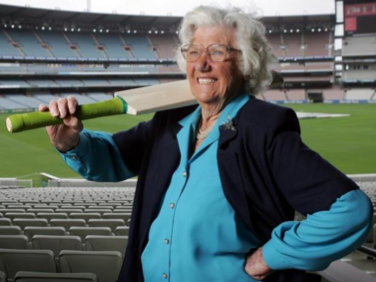
Elizabeth Rebecca (Betty) Wilson
1921-2010
Cricketer, sportswoman known as 'The female Bradman'
James Wood
1854-1897
Architect
James was the fourth son of John Wood who was the owner of the Yorkshire Hotel, and the founder and senior partner of the Yorkshire Brewery Company. Despite his relative youth, James was the architect of Collingwood’s crowning industrial glory, the Yorkshire Brewery with its magnificent Brew Tower, completed in 1878 and still standing.
John Wood
1826-1878
Publican, liquor merchant, brewer, councillor, magistrate
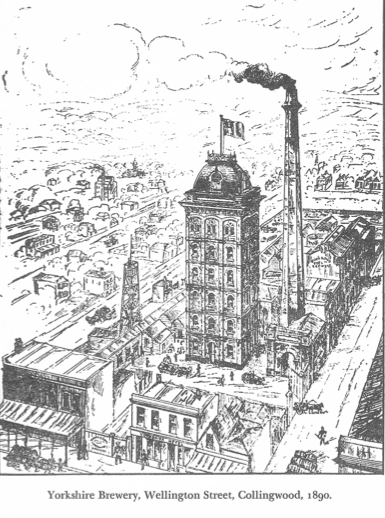
John Wood left his home in Yorkshire and arrived in Australia in 1848, aged twenty two. After a stint as a timber merchant in Fitzroy, he purchased a two acre site on the eastern side of Wellington Street in Collingwood, where he became in succession, the owner of the Yorkshire Hotel, and the founder of the Yorkshire Brewery Company. He also owned a wine and spirits store in Peel Street, on the Wellington Street corner. He was appointed a Justice of the Peace and occupied a seat in the Council of the Borough of East Collingwood.
John Woolcock
1842 - 1912
Butcher
John Woolcock started working life as a butcher on the Collingwood Flat and in the 1890s his business became an essential part of T K Bennet and Woolcock Ltd’s wholesale and retail meat and smallgoods network with branches in metropolitan Melbourne and throughout Victoria. He raised a large family in Collingwood where he acquired extensive property holdings.
Marjorie Woolcock
1898 - 1998
Sculptor, painter, printmaker
Born into a well-known Clifton Hill family in 1898, Marjorie lived in Gold Street Clifton Hill for over 30 years, and developed an artistic career, focusing initially on sculpture but mainly making her name with painting and printmaking. Her father was Frederick Woolcock, son of butchering magnate John Woolcock. Her mother was Robena Black, from Abbotsford. Frederick and Robena were married in Gold Street by Presbyterian minister Daniel McKenzie whose manse was a few doors away from their home. Marjorie was their first child, born at her grandparents’ house in Ivanhoe, and living at 211 Gold St and 217 Gold Street until the early 1930s.
Violet Woolcock
1900 - 1960
Violinist, music teacher, biology teacher
Violet was born into a well-known Clifton Hill family in 1900, lived in Gold Street, Clifton Hill for over 30 years, became a noted violinist, graduated as Bachelor of Music, and then taught music both at the Conservatorium and at the family home before making a surprising career change in her thirties.
John Wren
1871-1953
Bookmaker, tote operator, businessman, entrepreneur, racecourse owner, Collingwood Football Club supporter
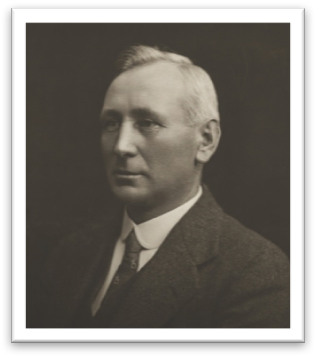
Born of illiterate Irish immigrants (John Wren and his wife Margaret, formerly Nester) in Ballarat Street, Collingwood in 1871, John Wren like many Collingwood boys left school early and commenced his working life in the boot trade, working at Whybrow's boot factory. Some stories say that while there he added to his income by a small scale bookmaking operation. Others suggest that he worked for a bookie after his retrenchment from Whybrow's in the 1891/1892 economic slump. Another story is that it was a win on the Melbourne Cup that allowed him to set up his bookmaking business behind the facade of a shop (at various times described as selling tea or tobacco) in Johnston Street, Collingwood.
James Evans Yates
1820 - 1902
Hairdresser
James Yates was a hairdresser (with the typical sideline as a tobacconist) in Smith Street for many decades. After his death he became well-known for the benevolent disposal of his assets, but is nowadays remembered as the original owner of Portia in Victoria Parade, a handsome building which has largely withstood the ravages of time and development. Victoria Parade was conceived as a grand boulevard and residences such as Portia remain key contributors to the retention of its character.